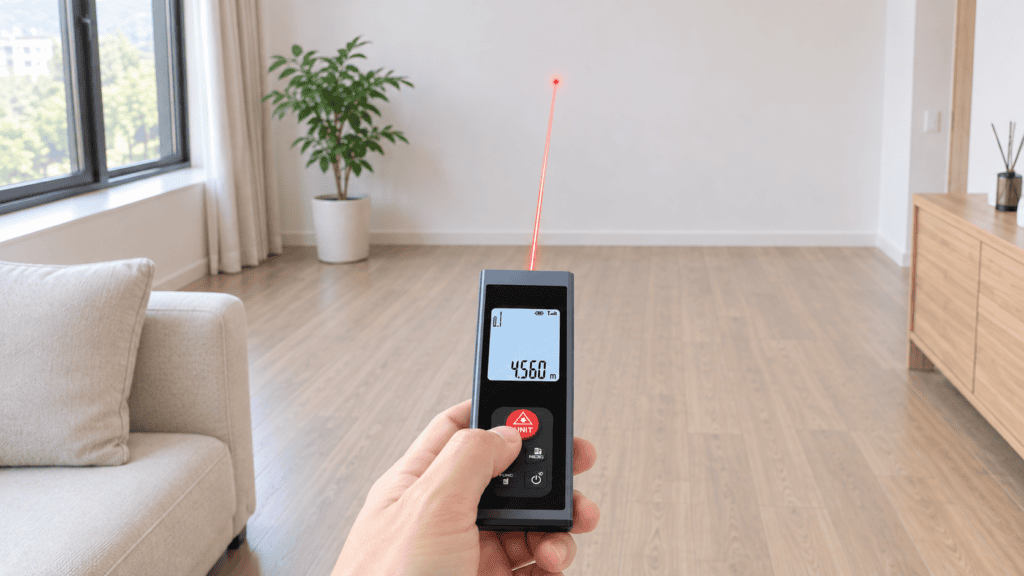
How to Measure a Room with a Laser Measure
Measuring a room sounds like the easy part of a renovation. In practice, it’s where the money leaks: a width measured across the sofa, a height measured to the drop ceiling instead of the real one, a corner nobody could stand in. Every one of these becomes a material order that doesn’t fit.
A laser measure takes most of the human error out of the job. You get 2 mm accuracy at the press of a button instead of a sagging steel tape and a helper who lets go too early. (Still choosing between the two tools? We’ve already tested laser measure vs tape measure for accuracy, and written a laser distance meter buying guide that covers the 5 specs actually worth paying for.)
https://kinlopto.com/laser-distance-meter-buying-guide/
Here’s the whole process, step by step.
🧰 What you need
- A laser distance meter. Anything with an area mode works. Pythagoras mode is nice for blocked corners and vaulted ceilings, but not essential.
- Your phone or a notepad. Some meters with Bluetooth log each measurement into an app, which saves a lot of scribbling.
- A bit of painter’s tape if you want to mark reference points on a long wall.
No ladder, no second person, no calculator.
📐 Step 1: measure the floor area
A normal rectangular room
Stand in one corner and shoot the laser low along the floor at the opposite wall, so the dot lands on the skirting board. That’s your length. Turn and shoot the adjacent wall for the width.
Floor area = length × width.
Better yet, don’t do the math yourself. Most laser measures have an area mode, usually marked with a square icon. Measure the two sides once and the meter multiplies them and shows the result. It’s the mode you’ll use most, so check it exists before you buy.
A worked example. Say the bedroom measures 4.32 m by 3.55 m:
4.32 × 3.55 = 15.34 m² (about 165 sq ft)
An L-shaped or odd-shaped room
Split it into rectangles, measure each one, add the areas. Two or three shots per section, and the whole room takes maybe two minutes.
One tip: aim at the skirting board, not at whatever furniture is standing against the wall. The laser travels in a perfectly straight line, but if the dot lands on a sofa, you’ll happily write down the distance to the sofa and wonder later why the new carpet doesn’t fit.
🧱 Step 2: measure the walls and the ceiling
For wall work you want two numbers: the perimeter and the height.
The perimeter needs just two measurements. Measure the length of wall 1 and the length of wall 2 (two adjacent walls), then:
Perimeter = (wall 1 + wall 2) × 2
The example room: (4.32 + 3.55) × 2 = 15.74 m around
The ceiling height is one shot. Stand anywhere in the room and shoot straight up. If the dot is hard to see on a white ceiling in bright light, stick a dark sticky note up there as a target.
The example room: 2.65 m from floor to ceiling
If you want per-wall numbers instead of the total, measure each wall on its own and write them down separately. Takes longer but it’s the better choice if the room has alcoves, a built-in wardrobe, or a half wall. Remember that openings like doors and windows sit inside these lengths, so note where they are while you’re at it.
🌀 Step 3: reach the places you can’t stand in
The corner is blocked by a radiator, or the room is full of boxes. That’s what Pythagoras mode is for. Shoot two sides of a triangle from wherever you can stand, and the meter works out the third side.
Say you can’t get into the corner of the example room. Stand 1 m out along one wall, shoot across to the far wall and diagonally, and the meter calculates the corner-to-corner distance you couldn’t measure directly. Two shots instead of one, no moving furniture.
The same mode also handles high or awkward diagonals: measuring up a stairwell, across a vaulted ceiling, or from a doorway to the far corner of a long room.
⚠️ 5 ways people get this wrong
- Measuring across furniture. The dot lands on the sofa and the sofa becomes the wall. Shoot low, aim at the skirting.
- Shoving the meter into a corner. Most models can’t measure anything closer than about 5 cm. If you’re jammed against the wall you’ll get an error, not a reading.
- Trusting a reading off glass. The beam bounces off mirrors and windows and comes back wrong, sometimes double the real distance. Aim at the frame instead. This is one of the most common causes of inaccurate laser measure readings, and it confuses people every day.
- Measuring to the wrong ceiling. In rooms with beams, soffits, or suspended sections, the dot 30 cm in from the wall might be hitting a dropped bulkhead, not the real ceiling. Shoot from the middle of the room.
- Writing down numbers without units or locations. “3.2” is useless an hour later. “3.20 m, north wall” still makes sense when you’re at the store. If your meter has Bluetooth, let the app do this part.
✅ What the 5 minutes gets you
Measured properly, the example room gives you six numbers: length 4.32 m, width 3.55 m, floor area 15.34 m², perimeter 15.74 m, ceiling height 2.65 m, and a 5.62 m corner-to-corner diagonal from Pythagoras mode. Write them down with units and which wall they came from, and every material order that follows starts from solid ground.
❓ FAQ
How accurate is a laser measure for rooms? Consumer models are accurate to 2 or 3 mm. That’s tighter than any tape you can stretch across a furnished room.
Can I measure ceiling height with it? Yes. Stand anywhere in the room and shoot straight up. If the dot is hard to see on a white ceiling in bright light, stick a dark sticky note up there as a target.
What is area mode? A built-in function that measures length and width and multiplies them for you, displaying the result in m² or ft². If you’re buying a meter mainly for room work, this is the mode that matters.
What if I can’t stand in the corner? Use Pythagoras mode. Shoot two sides of a triangle from wherever you can stand and the meter works out the third side. Handy when a corner is blocked by a radiator or a bookcase.
Does sunlight mess up the readings? Not indoors. Outside, bright sun washes out the dot and real-world range drops to roughly 40 to 60% of what the box claims. We’ll get into outdoor measuring and green-beam options in a separate guide.